The palindrome on Euler's lattice
In 1739 Leonhard Euler drew the notes of just intonation as a lattice: one step up is a pure fifth 3:2, one step to the right a pure major third 5:4. Every note made of fifths, thirds and octaves has exactly one place on it. Lluis met this grid years ago under another name, a “matrix of fifths”, and recognised it as Euler’s just-intonation lattice (the ancestor of the Tonnetz) laid out as concentric squares. He found mirrors in it, as in all-fourths tuning. Here the palindrome walks on it, and its mirror becomes a picture.
1 · The lattice
Click a note to hear it with C, and see its mirror partner through C.
Colours (Lluis's, from his study): an interval and its inversion share a colour. C the centre · fifth / fourth · major third / minor sixth · minor third / major sixth · major seventh / semitone · tone / minor seventh · tritone. The colour follows the 12-tone key, so a whole diagonal of the lattice can share it. The arrows show where each interval goes from C; each one continues (dashed) to the same interval again, and its mirror arrow points the opposite way.
Up: a fifth 3:2. Right: a pure major third 5:4. The small numbers count syntonic commas (81/80, 21.5 cents), as in the matrix: E₁ is the pure third 5/4, a comma below the Pythagorean E 81/64; A¹♭ is the minor sixth 8/5, a comma above the Pythagorean A♭ 128/81. Reflecting through C sends every note to its inversion: the major third E₁ and the minor sixth A¹♭, the fifth G and the fourth F, the minor third E¹♭ and the major sixth A₁ swap places. proved
2 · The melody walks
With the silence as 0 the melody only uses C, G and F: it lives on the column of fifths, and the silences are rests. With the silence as 5 the major third E₁ joins: the melody opens the second axis of the lattice. Either way the path is retraced backwards in the second half, so every leap comes back as its opposite: a fifth up returns as a fourth up (a fifth down, an octave apart), a major third as a minor sixth. The table counts each leap next to its mirror partner; at n = 50 every pair is equal. proved
This is what any palindrome looks like here (the path read backwards); what the lattice adds is that "backwards" is musical inversion, the same mirror as in section 1. In the harmonics reading (with the 5) all the leaps are consonances and every period closes: its 25 leaps add up to zero. computed The lattice ignores octaves, so a leap is named by its interval within the octave.
3 · The chord roots: the comma made visible
The root rule of Chord progressions: a fifth moves the root up a fifth, a fourth up a fourth, the unison and the octave stay, a silence rests, and, with the silence as 5, a 5 moves the root up a pure major third. Play two periods (n = 1 … 50).
On 0 the root walks up and down the column of fifths only, and after every period it is home: four fifths and four fourths are exactly four octaves, in just intonation and in 12 tones alike. proved On 5 the fifths and fourths still cancel, but the nine major thirds of each period carry the root nine places to the right, and it never comes back: on the lattice no number of pure thirds makes octaves. In 12 tones three major thirds are an octave, so the circle closes and the root is home after every period (left: the 12-tone circle). The gap is the difference between the two worlds: after one period the just root lies 123.2 cents below the 12-tone C, after two periods 246.4. computed
Each pure third 5/4 is 386.3 cents, 13.7 cents smaller than the tempered third: three of them fall short of the octave by the diesis 128/125 (41.1 cents), nine by three dieses. Tunings that want pure thirds, like the 31-tone division of Colonna's Sambuca lincea (1618), have to bend the lattice in a different way; that is for a later exploration.
4 · The same mirror on the guitar and on the circle
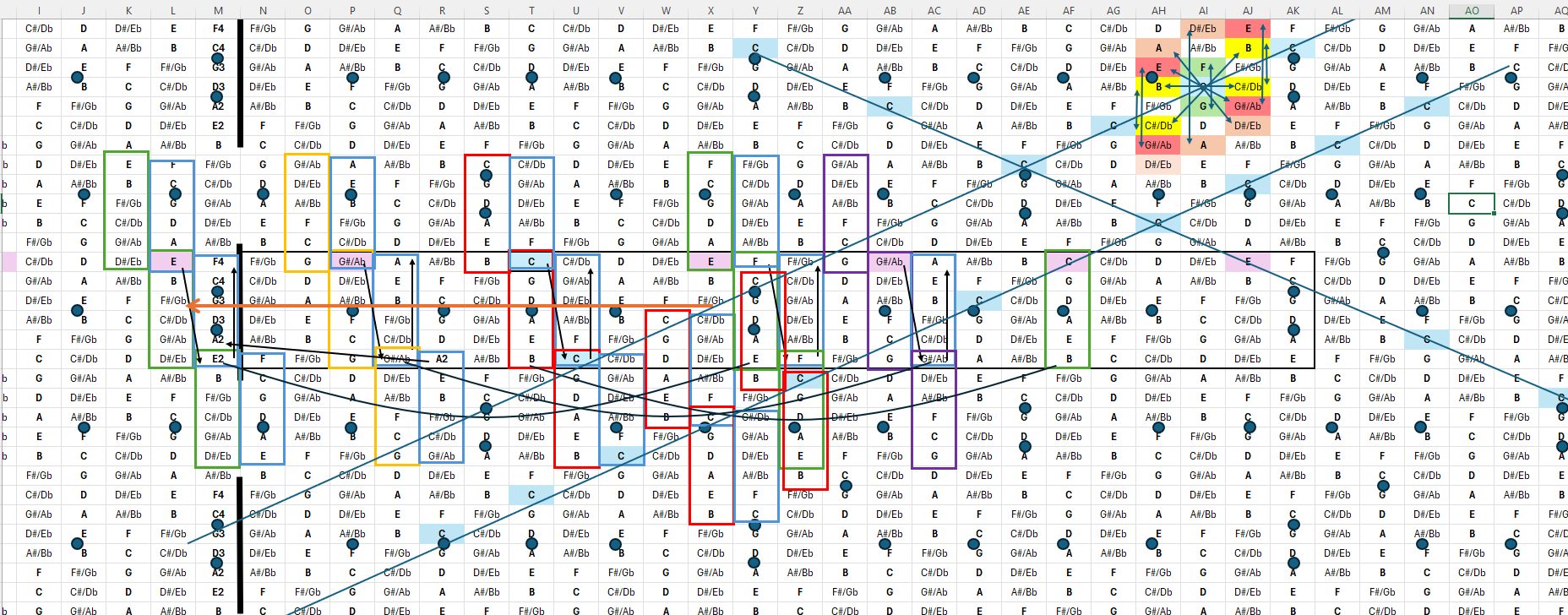
On the guitar. In all-fourths tuning the fretboard is the same kind of lattice, with fourths across the strings and semitones along them, in 12 tones. Reflect it through a root and every interval lands on its inversion, in the same colours. Click a note to see its partner; the full tool, with more strings, tunings, the mirror across fret 12 and the palindrome, is The mirror fretboard.
On the circle. Put the twelve tones on a circle with C at the top and the mirror becomes a line: the vertical line through C and F♯. Every note faces its inversion across it, in the chromatic order and in the order of fifths alike; C and the tritone F♯ are the two places that stay, like the two mirrors of the palindrome. proved
Coltrane's circle, as Lluis studied it. John Coltrane's famous circle drawing (the one he gave to Yusef Lateef) writes the chromatic scale five times around a circle in two rows, the two whole-tone scales, with the five C's joined in a pentagram. Below is a representation of Coltrane's circle, with what Lluis marked on it in his study:
- the red path climbs by fourths from C, clockwise: C, F, B♭, E♭, A♭, D♭; the blue path climbs by fifths, counterclockwise: C, G, D, A, E, B. They are mirror images across the vertical line, and after five steps they stop on the two neighbours of C, D♭ and B: the semitone and the major seventh, mirror partners again. proved
- the black lines across the top join each note to its mirror: A♭–E, B♭–D, G–F, A–E♭, B–D♭ (in the pair colours);
- the pentagram joins the five C's (1 to 5), each outer note is grouped with both inner notes beside it (C with B and with D♭, D with D♭ and with E♭, …): a semitone below and a semitone above, the two mirror partners of the semitone pair, so a small mirror sits on every outer note; and the lines across the circle join each place to the opposite one, a tritone away: the other mirror.
Lluis's study (2024). His all-fourths fretboard table, where he first marked the mirrors: the boxes are the same notes on neighbouring strings, and the arcs join each pattern to its mirror across the board.
5 · Notes and credits
The lattice is Leonhard Euler's (Tentamen novae theoriae musicae, 1739). Drawn with triangles and folded into the twelve tones, it is the Tonnetz that Arthur von Oettingen and Hugo Riemann took up in the 19th century and that musicians use today to see chords and their neighbours. The small numbers on the notes count syntonic commas.
The mirror of section 1 is the classical inversion of intervals. What is new here is to watch the Pentametric palindrome on the lattice: its notes, its leaps paired with their mirrors, the second axis opened by the 5, and the chord roots drifting by the comma. Lluis saw these mirrors (on the matrix, the all-fourths fretboard and Coltrane's circle) before he found the palindrome. computed